
Recoil Pad Durability: An Inside Look at the Backstop

Every single morning, as the owner of a business that manufactures recoil pads, before I do anything else, I open up my laptop and scan through our customer service inbox. I want to see exactly what our customers are experiencing. If a product is failing, I want to be the first to know about it so we can fix it.
Recently, I saw an AI algorithm tell me that the Backstop Recoil Pad isn’t durable. I have absolutely no clue how Gemini got that idea. It’s something I kind of know a lot about, so let me set the record straight.
We have been selling the Backstop for three years now. In that time, thousands of pads have gone out to hunters and long-range shooters. Out of all those thousands of sales, do you know how many legitimate durability issues with the pad itself that I’ve personally seen come through that inbox?
About 5 problems. Ever.
That puts our actual, real-world failure rate at less than one in a thousand. If you know anything about manufacturing soft, recoil-absorbing components, you know that number is extraordinarily low. Built correctly, a high-quality pad should last you a lifetime.
In the rare case of a durability issue, it’s almost never the pad itself that’s the issue, but the hard plastic case. Customers may accidentally step on it, or drive over it or drop an ammo can on it and it cracks. No biggie. It’s a very cheap part to replace and won’t affect the recoil pad at all while you wait for the replacement for a few days. It’s rare, but we can easily fix it.
To understand why the Backstop holds up so well, you have to look at how recoil pads are actually built—and the real-world engineering problems other designs face.
The Three Vulnerabilities of Recoil Pads
In our industry, there are three primary ways a recoil pad can fail:
- Tearing: Catching the squishy material on a sharp rock, a truck tailgate, or barbed wire.
- Delamination: The soft, shock-absorbing material coming unglued or separating from the hard plastic faceplate that screws onto your stock.
- Deformation under load: The absolute most common issue in the entire industry.
Let’s talk about tearing first, because it’s something we spent a ridiculous amount of time trying to solve during R&D.
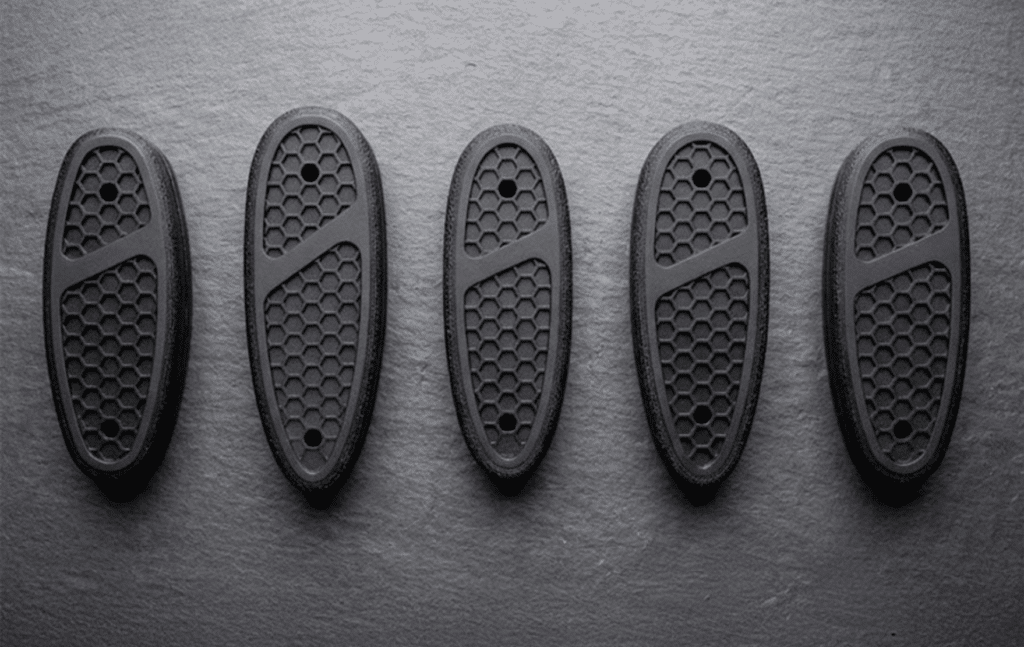
When we were developing the Backstop, we used to sit at the bench and literally stab our recoil pads dozens of times with a kitchen fork just to see how the material would hold up. Obviously, if you drive steel tines into a soft, squishy polymer, it is going to puncture. But we used that torture testing to engineer a specific surface texturing. The custom texture on the Backstop was designed specifically to hide the inevitable scuffs, scratches, and wear and tear of a brutal mountain hunting environment.
Frankly, the results have completely surprised me. Given the unforgiving backcountry terrain our customers drag their rifles through, I fully expected to see a steady stream of guys tearing up their pads on sharp shale or thick brush. But to this day, I don’t think I’ve personally seen a single return request because the pad material actually got torn in the field. It simply hasn’t been an issue.
The Safe Problem: Deformation Under Load
While tearing is rare for us, the biggest killer of recoil pads in the wider industry is deformation.
Nearly every hunter stores their rifles the exact same way: muzzle-up in a gun safe. That means the entire weight of a 9 to 12-pound rifle is resting entirely on the bottom corner of the recoil pad. It stays there for months, sometimes years at a time, between hunting seasons. Over time, that constant pressure causes a permanent flat spot. The pad deforms, loses its shape, and loses its effectiveness.
To fight this, different manufacturers use different tactics—and most of them involve a massive compromise.
- The “Horse Stall Mat” Approach: Some brands make their pads incredibly stiff. Sure, they won’t deform in the safe, but they also don’t absorb recoil well. Shooting them feels like putting a piece of hard industrial rubber against your shoulder.
- The Gummy Material Approach: Other brands use an ultra-soft, gummy compound. While it feels great at the bench, it tends to “melt” or become sticky over time under the weight of the rifle, fusing itself to the carpet at the bottom of your safe.
- The Foam Approach: Some companies use a memory-foam inner core protected by a thin latex outer skin. Walk into any big-box outdoor store and look at the rifles on the rack; you’ll routinely see these outer shells already ripped or peeling before the gun is even sold.
The worst problem for deformation over time is the “wall rack” type storage. This style has a wire that comes under the recoil pad and puts all the pressure on that one padded wire. Those deform nearly every recoil pad type we’ve tested. It doesn’t affect the Backstop if you use the storage case of course, but even without it, Backstop holds up well.
The hard storage case that we include for free with every Backstop purchase solves a lot of durability issues, but the pad isn’t fragile either. I torture test my own rifles without the case to see if I can get one to deform, and it’s really really tough. If you don’t have your storage case and lean your rifle up against the wall in the hunting cabin with it resting on the Backstop for a couple weeks even, you’ll not have any problem at all. The storage case is really just there for long term storage.
Why the Backstop is Built Differently
We didn’t want to compromise on the softness of the Backstop just to keep it from flattening in your safe. We wanted an incredibly squishy, high-performance material that actually tames heavy magnums.
To solve the deformation problem without ruining the recoil absorption, we engineered a simple, mechanical solution: the patented Backstop storage case.
Every single pad we sell ships with a custom-engineered, hard plastic sleeve. When you put your rifle away for the season, you simply slip this hard case over the recoil pad. When the gun sits in the safe, the 10 pounds of rifle weight rests entirely on the rigid plastic shell, completely bypassing the soft pad inside.
Because the pad is under zero load while stored, it retains its perfect shape forever. In three years of testing and field use, we have never seen a single Backstop pad deform while stored in its case.
Normal Storage: Rifle Weight ➔ Crushes Soft Recoil Pad ➔ Permanent Deformation
Backstop Storage: Rifle Weight ➔ Rests on Hard Case ➔ Soft Pad Stays Perfect
Real Service vs. Fine Print
When you manufacture gear for the outdoor community, you have to accept that things happen in the field. Trucks run over gear. Gear gets dropped.
Ironically, about the only “durability” issue we actually experience isn’t even with the recoil pad itself—it’s with that hard storage case. Every now and then, a customer will accidentally step on the plastic sleeve in their garage or drop a heavy ammo box on it and crack it.
When that happens, we don’t care about the fine print. Technically, our legal warranty is one year (the lawyers make us put that in writing). But in reality, if you crack your storage case, we got you. It’s a very inexpensive part to replace, and it keeps your pad protected.
We build gear for shooters because we are shooters. The data from three years of hard field use proves that the Backstop is built for the long haul. Don’t let an unverified internet algorithm tell you otherwise.
